
I Found This in an Old Notebook
I hope you had a nice weekend.
Recently, I found an old notebook from a trip to Zambia.
On December 8th, 2008, I was sitting in a hotel room in Lusaka watching the sun come up. The world was in the middle of a financial crisis.
At 4.30 that morning, unable to sleep, I opened this notebook and started writing.
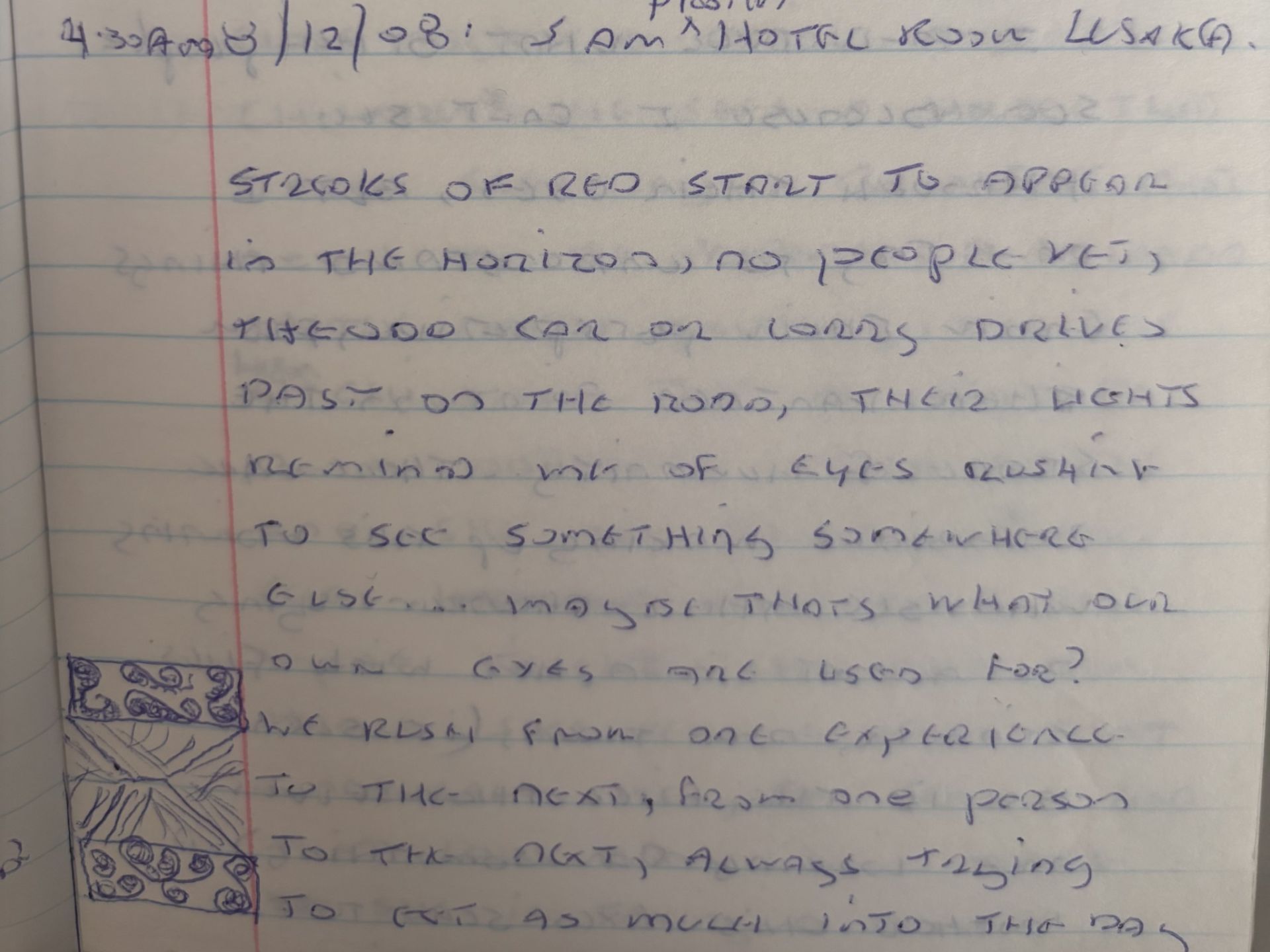
I wrote:
“Streaks of red start to appear on the horizon. No people yet, just the odd car or lorry driving past, their headlights reminding me of our eyes rushing to see something elsewhere.
Maybe that’s what my eyes are used for. I seem to rush from one experience to the next, always trying to get as much into the day as possible to make myself feel more fulfilled.
What if I didn’t rush?”
The previous day, while accompanying a Zambian nurse-midwife on her visits, I had met a woman living with HIV.
Antiretroviral medication was helping her live what I described in my notebook as “a purposeful life in the service of others.” But she was worried that international funding for the medication might disappear as governments responded to the financial crisis.
Before I left, she asked something of me:
“Please tell your friends not to stop sending us these drugs, or without them, my children will be orphans.”
I have never forgotten those words.
The following morning, as I watched the sunrise, I tried to imagine what she might be seeing as the same sun appeared outside her home.
In my notebook, I imagined the breakfast that needed preparing, the veranda that needed brushing, her concern that she had lost more weight, and her Bible with highlighted verses that gave her strength.
Nearly eighteen years later, I realise something about my attempt to imagine her morning.
I still couldn’t see through her eyes.
I could only see through mine.
Perhaps that is where empathy begins. Not by convincing ourselves that we understand exactly what another person is experiencing, but by having the humility to accept that we don’t.
We can, however, become curious about their vantage point, and that matters enormously in leadership and in life.
“I can’t tell what others see because I can’t see through their eyes, but I can make a decision to better understand their vantage point.”
From my notebook, Lusaka, 2008.
I think that matters enormously in leadership and in life.
We can quickly label someone as difficult, resistant or wrong because their response makes little sense from where we are standing.
But perhaps before responding, there is a better question we can ask.
What can they see from where they are standing that I cannot see from here?
Perhaps there is someone in your life this week whose response you are struggling to understand.
You don’t have to agree with them. You don’t have to pretend you know what it feels like to stand where they stand.
Just become curious about the view.
The sunrise may be the same. The view rarely is.